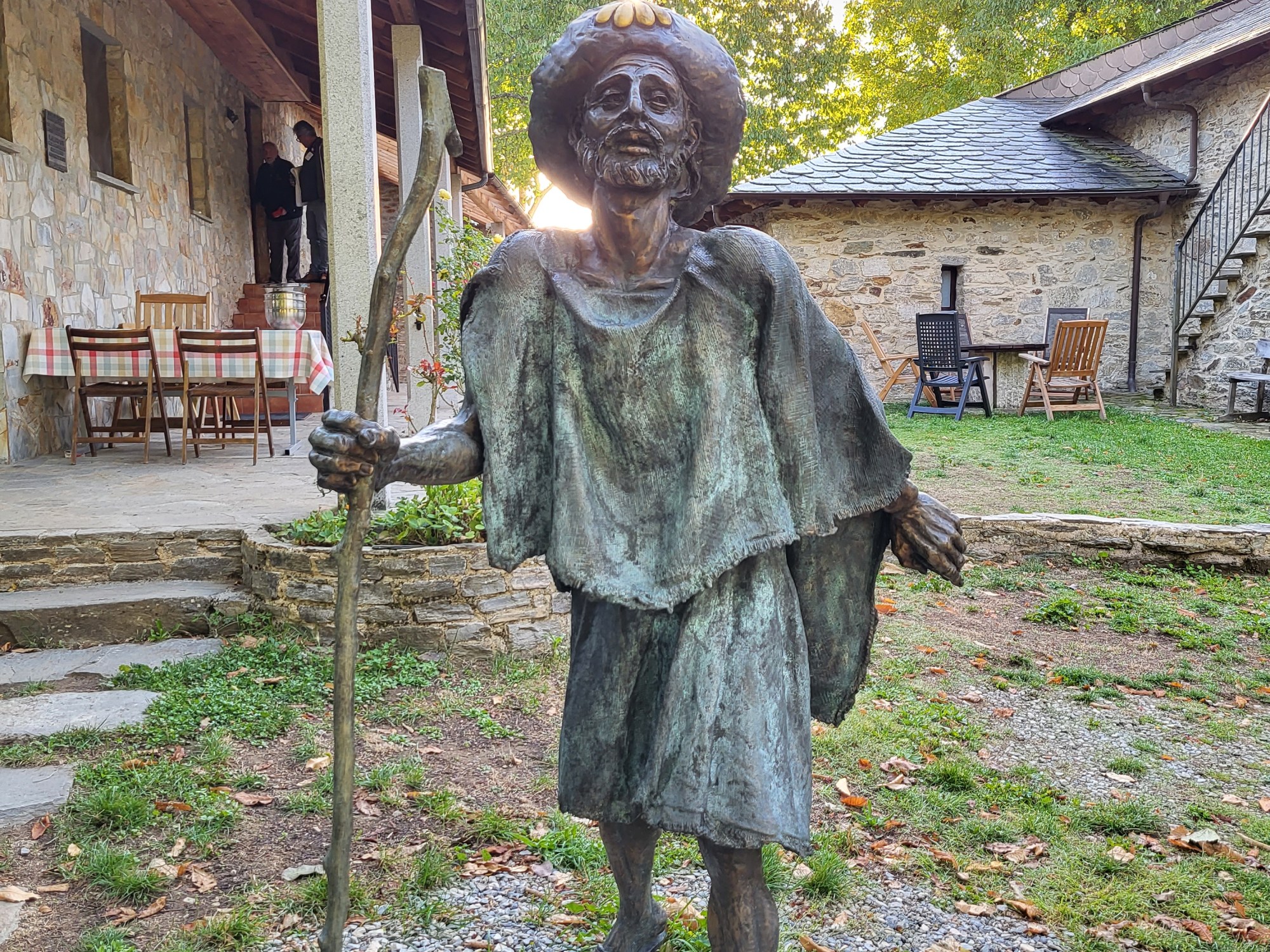
When you hear the word, your mind might conjure up images of early English colonists sitting around a Thanksgiving table…
- Or maybe John Wayne calling someone this right before he pummels them and saves the world?
- Or maybe the creepy guy pictured on the Quaker Oatmeal box?
- Or, if you’re a devoted and well-read Protestant, Bunyan’s Pilgrim’s Progress?
- Or if a millennial movie buff, Scott Pilgrim vs. The World?
It’s interesting how the word has strayed from the original pilgrim idea. From a religious perspective, a pilgrim is a religious devotee, someone figuratively journeying along the path of their religion. And pilgrims are literally serious enough to take pilgrimages (a trip to a holy or special place). The Hebrews to Jerusalem. Hindus to the Ganges. Buddhists to Bodh Gaya or Kailosh. Muslims to Mecca. Christians to Jerusalem, Rome, or Santiago de Compestela.
The technical definition of a pilgrim, according to the Oxford English Dictionary is: “noun – a person who journeys to a holy place for religious reasons.”
From a historical Christian perspective, it means a sojourner, a traveler that travels away from his own people. Pilgrim is used metaphorically of those to whom heaven is their home country and who are just temporary travelers on this earth. Pope Francis expands this idea:
“…to be a pilgrim means primarily to be in movement, to be uninstalled, to go out from stillness, which becomes a comfort that paralyzes and waits – inactive, routine, formalistic – and to advance free of conditions, to read with realism the events of existence.”
David Whyte, Anglo-Irish poet, asserts that most of us are pilgrims, though we may not find ourselves on a specific pilgrimage trek:
“Pilgrim is a word that accurately describes the average human being; someone on their way somewhere else, but someone never quite knowing whether the destination or the path stands first in importance; someone who underneath it all doesn’t quite understand from whence or from where their next bite of bread will come; someone dependent on help from absolute strangers and from those who travel with them.”
Today I finished the book, Journey to Portugal by José Saramago. At the end of the book, he adds what I think is a suitable addition to the definition of a pilgrim (traveler):
The Traveler Sets Out Again
“But that is not true. The journey is never over. Only travelers come to an end. But even then, they can prolong their voyage in their memories, in recollections, in stories. When the traveler sat in the sand and declared: “There’s nothing more to see,” he knew it wasn’t true. The end of one journey is simply the start of another. You have to see what you missed the first time, see again what you already saw, see in springtime what you saw in summer, in daylight what you saw at night, see the sun shining where you saw the rain falling, see the crops growing, the fruit ripen, the stone which has moved, the shadow that was not there before. You have to go back to the footsteps already taken, to go over them again or add fresh ones alongside them. You have to start the journey anew. The traveler sets out once more.”
Well said.
 Pilgrims and Prophets
That is remarkably beautiful!
The book is pretty good…a travel journal, written in the 3rd person and a little snarky!